
-
Please note: This version of the Wiki is in the process of being replaced. Previous styling code may not render correctly in parts.
Lepotitsa
- Views Views: 1,697
- Last updated Last updated:
- Redirect Redirected from Lepotica
-
Lepotitsa 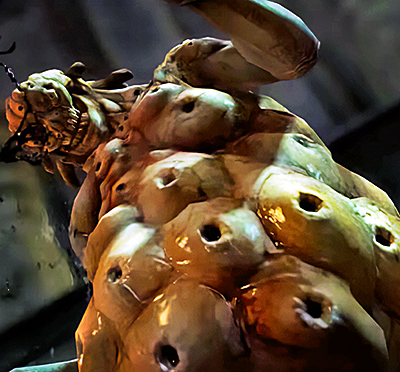
Character
Debut: RE6 Voice (E): - Voice (J): - Biography
Age: - Birthplace: - Birthday: - Blood: - Height: - Weight: - Occupation: - Family: - Appearances
Games: RE6 Films: - Novels: - Lepotitsa (which means "Beauty" - but feminine, in Serbian) is one of the evolutions (sometimes referred to as Complete Mutations) that can occur from a C-Virus infected person emerges from their Chrysalis. A typical infected such as a J'avo will usually enter a Chrysalid state once they have sustained a lot of damage, but sometimes an infected person can enter a Chrysalis almost instantly, possibly depending on will or emotional state. With the Lepotitsa, it takes on the form of humanoid monster with bulging growths dotted around its body which release many different kinds of spores, ranging from toxic to poisonous and also it can spread the C-Virus. In fact, at the start of the Tall Oaks outbreak, many were planted strategically in order to do just that.
It was widely known that this Chrysalid was developed in-house at Neo Umbrella by Derek C. Simmons and his team (which included Carla Radames) in their quest to create a clone of Ada Wong. This obviously failed on this occasion, and in it's place this lumbering monster was created. It attacks primarily with its sharp claws and its tongue, which it can use to infect others, but it also indirectly causes pain to thousands by being one of the primary spreaders of the C-Virus. So if one were to be encountered, it had to be killed in order to stop or at least control the spread.
It has a skeletal face with a large growth on the top of their heads which looks brain-like, but instead simply houses more smaller spore points. They can open their mouths so wide that their entire head folds back, revealing all of the flesh inside along with their giant tongue. This is a weak point which can be taken advantage of if given the opportunity.
The creature is also known as "Lepotica", which is in fact the correct translation from Serbian, but in Resident Evil 6 the creature is referred to as Leoptitsa throughout most likely as the original Japanese is "レポティッツァ" - "Repotittsua" and sometimes Japanese to English translation can be quite a task.